Claude Code in the agent panel
Your Claude subscription drives termide's agent, with termide's tools, permission cards and editor around it
You already pay for Claude, and Claude Code is signed in on your machine. You could run claude in one of termide’s terminal panels, and it would work, but it would live beside termide rather than inside it: its edits land on disk behind the back of the open editor, its permission prompts are its own, and its sessions are not termide’s.
termide’s agent panel can run on Claude Code instead. The model and the subscription stay Claude’s; the tools, the permission cards, the session list and the editor that follows every edit are termide’s. This guide sets that up and shows what changes compared with Claude Code in a terminal.
What you need
- Node.js, with
npxonPATH. termide drives Claude Code through its adapter for the Agent Client Protocol,@agentclientprotocol/claude-agent-acp, and runs its latest release throughnpx. The copy in npm’s cache starts without asking the registry; termide looks for a newer release once per run in the background, and a new one starts from the next panel on. - Claude Code signed in. termide does not run a sign-in itself. If you use Claude Code already, you are set; otherwise run
claudein a terminal once and sign in with/login.
No API key: the connection works on the sign-in Claude Code already has, your subscription or your own key.
Add the connection
Open the settings with Alt+P and go to AI. Connections comes first. Pick + Add connection, and on the new connection’s page set Provider to Claude Code. The page sheds the fields Claude Code does not need — base URL, API key, the fallback context window — and the connection is named claude-code until you name it.
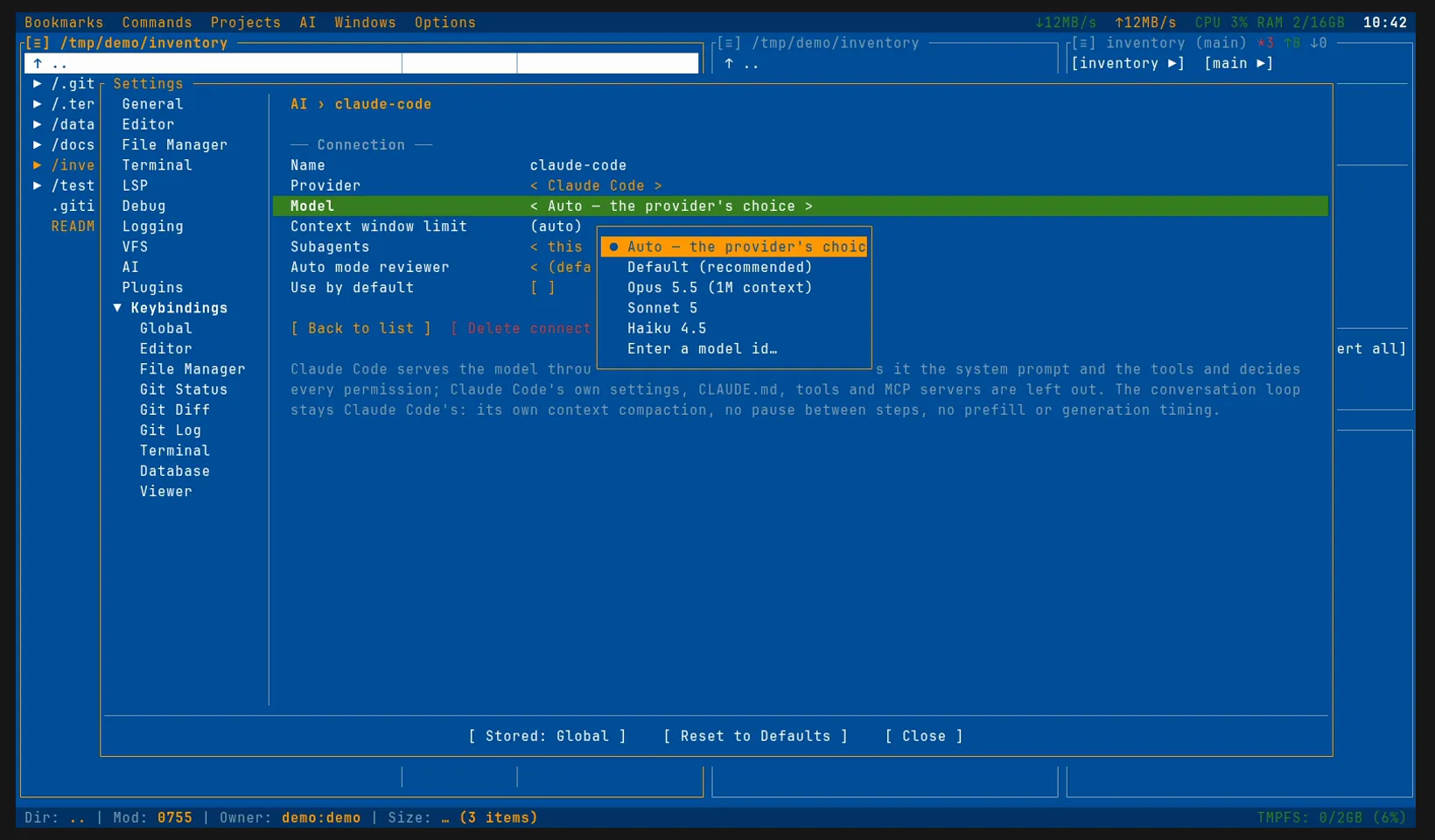
The rest of the page:
- Model: termide starts Claude Code for a moment and lists the models of your sign-in; a spinner turns in the field meanwhile. Auto — the provider’s choice leaves the pick to Claude Code. The model you choose is only the one pre-selected: in the panel you can switch at any time.
- Context window limit: leave it empty to keep the model’s window, or make it smaller, 100000 at least. Claude Code gets it as
CLAUDE_CODE_AUTO_COMPACT_WINDOWand compacts its conversation there, and the panel’sContext:shows no more than it. - Use by default: tick it, and new agent panels start on Claude Code.
The same in config.toml:
[ai]
connection = "claude"        # the connection new sessions start on

[ai.connections.claude]
provider = "claude_code"     # nothing else is required
# model = ""                 # empty: Claude Code's own default
# context_window_limit = 400000
The first request
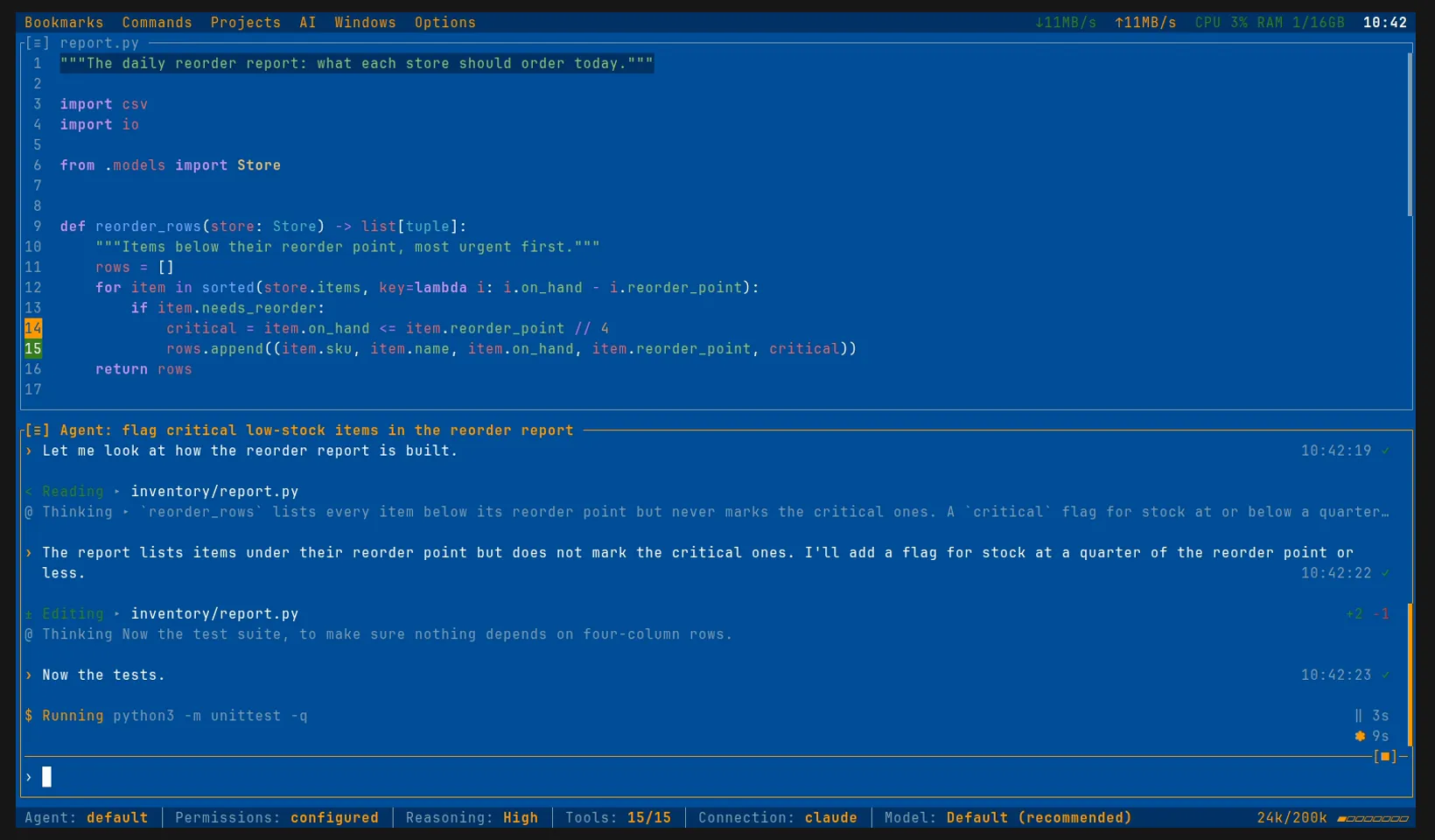
Open the agent panel with Alt+A. The banner shows the connection and the model; the Model chip in the status bar spins while Claude Code starts in the background, and a request sent meanwhile waits for it. Then the panel works as with any other connection: answers, reasoning and tool calls appear as blocks, an editor that has the file open follows each edit, and the run clock ticks until Claude Code is done.
The chips switch what Claude Code offers, at any time, during a run too:
- Model: the models of your sign-in, by the names Claude Code gives them.
- Reasoning: its reasoning effort.
- Options: the rest of its settings, fast mode for one.
Claude Code’s own / commands join the panel’s / list and go to it as typed; its /compact stands in for termide’s. A message typed while it works joins the turn it is running, as it would in Claude Code itself.
termide’s tools, not Claude Code’s
The key thing to know: in the panel, Claude Code runs on termide’s system prompt and termide’s tools, served to it over a local MCP server, in place of its own. Its built-in tools and its own settings are left out: its rules, hooks, MCP servers, and the CLAUDE.md it would load itself. What that gives you:
- One set of permissions. Every call goes through the same checks as termide’s own agent: the permission mode, your rules, the answers you gave in the session, plan mode, and
/undocheckpoints. - The tool checklist. The Tools chip lists termide’s tools, your skills and the tools of termide’s MCP servers; an unticked one is refused from the first request on.
- Your project instructions still count. termide reads
AGENTS.md, orCLAUDE.mdwhere there is noAGENTS.md, from every directory between the root and the panel’s working directory, and puts them into its own prompt. - MCP servers, skills and hooks go in termide’s config. Set them up once there, and they work the same whichever connection a session runs on.
The conversation loop stays Claude Code’s: it compacts its context itself (the compaction shows in the panel with its summary), and a run cannot pause between steps.
Permissions and auto mode
The Permissions chip (or Shift+Tab) sets the mode: ask, plan, edit, configured, auto, all. Anything the mode and the rules do not settle comes up as a card above the input: allow once, for the session, always in this project or everywhere, deny, deny and tell the agent why, or stop the run.
auto is for a run you trust in its direction but do not want to answer card after card. What would put a card up goes to a reviewer, a separate model call that decides whether the step serves what you asked for. On a Claude Code connection the reviewer runs through your subscription, on Haiku — the cheapest model the sign-in offers — with no API key; termide keeps the adapter running and asks each review in a short session of its own, without tools and without the agent’s conversation, so the agent never judges itself. A review takes a second or more and counts against the subscription’s limits. Another reviewer goes in Auto mode reviewer on the connection’s page or in [ai.auto_reviewer]:
[ai.auto_reviewer]
connection = "claude"   # empty: the session's own
model = "haiku"         # a model of it, by id, name or a part of either
Claude Code’s own auto mode is not used: termide’s reviewer judges every call.
When the limit runs out
A used-up subscription window ends the run with a card that knows when the limit resets, as Claude Code’s adapter reports it:
- Wait until 15:00 and try again,
- Try again now,
- Stop (Esc).
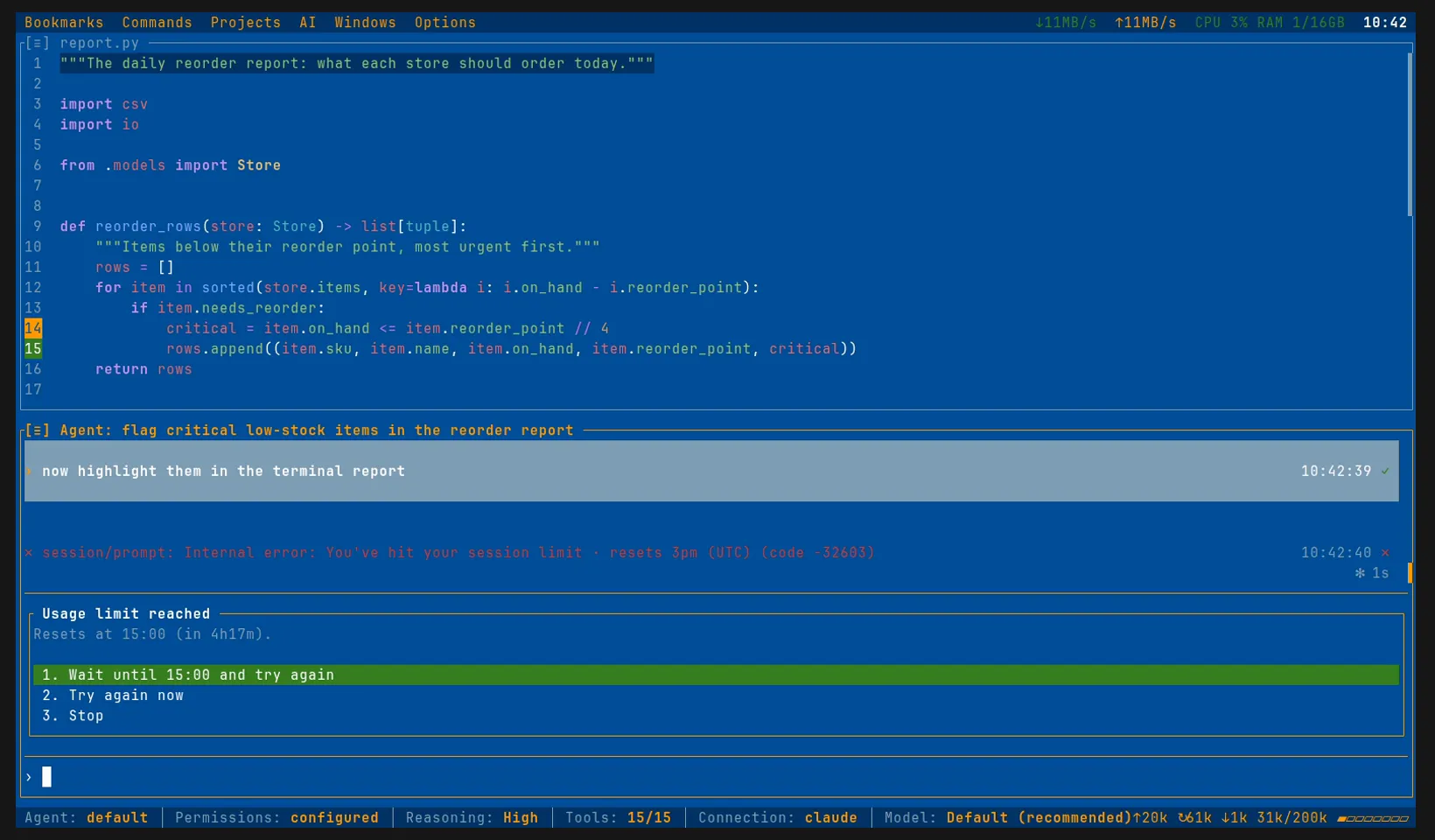
For an unattended /goal or /loop, set On a limit or outage (on_limit under [ai]) to wait, and the run waits for the reset and carries on by itself; ask_else_wait shows the card and waits if nobody answers. Closing termide meanwhile loses nothing: the reopened session brings the card back.
If you do not want to wait, keep a second connection. The status bar’s Connection chip stays clickable while the card is up: move the session to it, then answer Try again now. The conversation carries over, so the other model picks it up where Claude stopped:
[ai.connections.claude]
provider = "claude_code"

[ai.connections.api]
provider = "anthropic_compatible"
model = "claude-sonnet-5"
api_key_env = "ANTHROPIC_API_KEY"   # or store the key in termide's vault from the settings
A local model through llama.cpp or Ollama does as well, with provider = "openai_compatible" and its base_url.
Delegated tasks
When the agent hands a task over with task, the task runs as a copy of Claude Code: a session of its own, with the delegate’s prompt and termide’s tools, and its permission requests come to you in the delegating panel. To spend the subscription on the main conversation only, name another connection under Subagents on the Claude Code connection’s page:
[ai.connections.claude]
provider = "claude_code"
subagents = "local"     # delegated tasks run on the local model
It works the other way too: a session on a local model can hand its tasks to Claude Code.
Sessions and spending
The session log records Claude Code’s own session, so a reopened panel continues it, with the whole conversation and its tool calls known to Claude Code. A session that moved to Claude Code from another connection starts with a record of the conversation so far.
Session info (F3 or /usage) breaks the tokens down by who spent them — the conversation, delegates, the auto reviewer, and what Claude Code spends inside itself — and by model.
Good to know
- No sandbox. termide’s permissions are a control, not isolation: the commands you allow run with your rights.
- Codex and Gemini CLI connect the same way:
provider = "codex"or"gemini_cli". They keep their own system prompts and tools, and termide maps its permission mode onto theirs: Codex in the agent panel and Gemini CLI in the agent panel go through them. - Any OpenAI- or Anthropic-compatible API can be the second connection to move a session to when the limit runs out: a hosted one such as OpenAI, OpenRouter or Anthropic, or a server of your own, with termide’s own agent. llama.cpp and omlx are two examples of the latter.
- The details are in the agent guide.