An agent stops what it set going. A task handed over in the background ran to its end even when the agent no longer needed it — the plan had changed, another source had answered — and so did a delegate or command Claude Code had moved to the background to take your message: only you could stop them, from their row’s ✕, and asked to, the agent could only say it had no way to. The new jobs tool lists what the agent set going that still runs — background tasks, tasks parked at a limit, calls moved to the background — each with its id, what it is and how long it has run, and stop stops one of them without asking you, since it is the agent’s own work; no answer then comes from it, so the agent is not woken for nothing. The steps read & Listing background work and & Stopping <id>. A /goal or /loop stays yours. jobs comes with task.
A diagram wider than the agent panel pans sideways. A ```mermaid diagram in an answer wider than the panel was cut at its right edge, with no way to see the rest. Its rows now stay whole, with a scrollbar under it; the horizontal wheel or Shift+wheel over it, a click or drag on its scrollbar, or Shift+→/Shift+← with its answer picked in the chat pan it, while the ┊ bar stays put. A diagram that fits looks as before.
Writing to an agent that waits on a delegate reaches it at once. A message typed while the panel’s agent waited on a task call sat in the queue until the delegate finished, however long that took, so telling the agent the task no longer mattered came too late. Now the task moves to the background: the call returns with the task’s id, the task gets its row above the input, and its answer comes later as a message, so the agent reads your message straight away and can stop the task with jobs. Past the limit of messages agents pass one another without you, the task stays waited for.
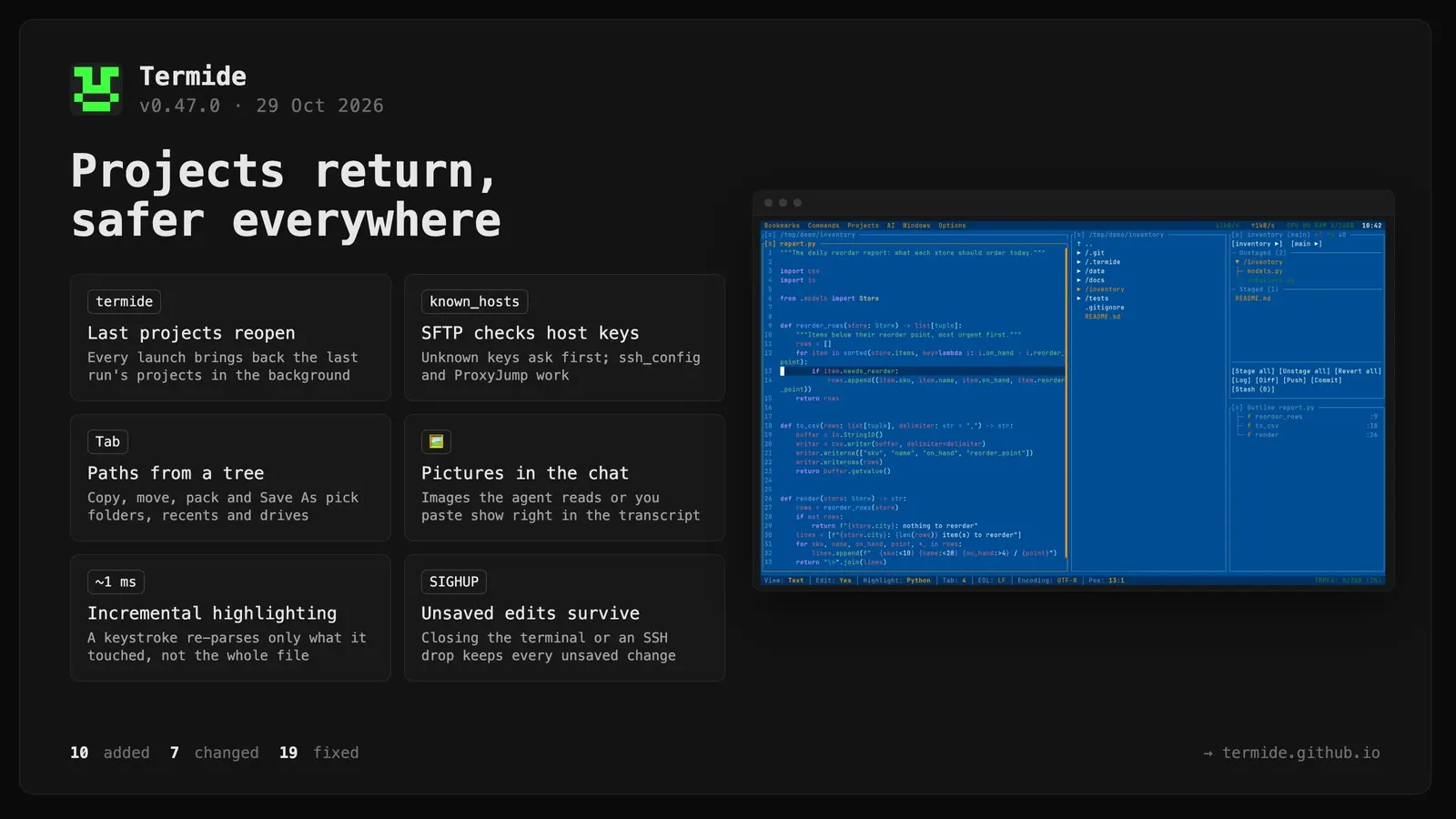
Destination paths picked from a directory tree. Copy, move, pack, unpack and Save As ask for their destination in one path field whose dropdown is a directory tree: Tab, a click or the arrow opens it, ↓ enters it, Enter keeps the path and Esc rolls it back. An untouched field lists the panels’ directories, then the destinations confirmed recently in the project (recent, kept until termide quits, never written to disk), then the drives or mount points (drive); an edited one lists the directory its text names, filtered fuzzily by the tail. Moving through the tree writes the path into the field, keeping a single file’s name; the tree creates, renames and deletes empty directories and shows hidden ones with the file manager’s keys. Pack picks the archive format on a row that swaps the extension.
Pictures in the agent transcript. A picture read returned shows under its call, even folded, and one you pasted shows inside your message, drawn with the terminal’s graphics (Kitty, Sixel, iTerm2, or half blocks), centred and no larger than half the panel’s height or width, whichever is more. It is drawn only while all of it is on screen, and on Sixel and iTerm2 only once it stops moving, so scrolling stays fast. An external agent’s view shows the pictures termide’s tools return too.
Long diagrams and written pages fold to a card. A Mermaid diagram taller than half the agent panel shows as a one-row card until its answer is unfolded by hand. A write of an HTML, Markdown or Mermaid file adds a card under its headline: a click or o opens the file in its viewer, Alt+click outside termide.
An agent debugs commands that take parameters, and steps without asking.debugstart refused any command with params; it now takes values by name, the rest keep their defaults, and each must fit its field. Stepping, pausing, stopping, breakpoints and frames ask no one outside plan mode, since the launch was already decided; start and evaluate stay with the rules, which now see what runs (start debug-server, evaluate <expr>) rather than the bare action. A debug call is headed with its localized action — → Debugging debug-server, ● Setting breakpoint src/main.rs:42 — instead of raw JSON.
SFTP checks server keys and follows ssh_config. Every server key used to be accepted, so anyone on the network path could pose as the server and take the password. Keys are now checked against known_hosts before anything is sent; an unknown host shows its key type and SHA256 fingerprint with Accept and remember, Accept once or Cancel (preselected), and a changed or revoked key is refused, naming the known_hosts line and the ssh-keygen -R command. ssh_config is read as OpenSSH reads it — the user and system files, first value wins, ! patterns, Include — and an sftp:// host may be a Host alias whose HostName, Port and User apply. ProxyJump is followed as ssh -J does, each jump host checked and logged in to with keys or the agent only; UserKnownHostsFile, GlobalKnownHostsFile, HostKeyAlias, HashKnownHosts and StrictHostKeyChecking yes are honoured, and %h, %p, %r and the other tokens are expanded.
A crashed language server restarts. A server that died stayed dead until termide restarted. It is now restarted up to three times within three minutes, every open document sent to it again, the editor title reading (restarting) meanwhile. Restart language server in the command palette and the editor’s menu restarts it at once — also one that failed to start, say with its binary installed afterwards.
ESC 7, ESC 8 and ESC c in the terminal. The terminal panel saves and restores the cursor with its style, and resets the screen while keeping the scrollback; escape sequences with intermediates such as ESC # 8 are no longer taken for their final byte.
Changed
termide --detached attaches to the instance it starts. Working in a detached instance took two commands, termide --detached and then termide --attach, for what is nearly always one intention. It now starts the instance and attaches straight away, the way tmux new does, and has the short form -d; Alt+D or a dropped connection leaves it running as before, and the client prints the --attach line to come back with. --detached --no-attach keeps the old behaviour, starting the instance and printing its id, for scripts. Without a terminal to attach from, a plain --detached is refused before anything starts, and says to add --no-attach.
The last run’s projects reopen at launch. Getting the working set back took termide --restore or a trip to the Projects menu after every start. Now every launch does it: the directory started in becomes the current project, joining the set when it was not in it, and the last run’s other projects open in the background around it, loading when first entered. Unlike --restore, an agent’s unfinished work in them — a failed request to try again, a goal to go on with — waits until its project is entered, so a plain termide sets nothing going on its own. Projects another instance has open stay with it, and those reopened are taken only when they first load, so a second termide can still start in one of them; the first then shows it crossed out. general.restore_projects (Reopen the last run’s projects in Settings → General) turns it off, and --no-restore skips it once; --restore still restores with the setting off and starts where the last run was. A launch given a path — $EDITOR, termide <dir> — restores nothing.
A project is open in one termide at a time. Two instances with the same project saved its layout over each other, ran its language servers twice, and both tried again the agent requests it left failed. Opening, creating or moving a project onto a directory another instance has open is now refused, and the status line names that instance — its pid, or the detached instance to attach to. Starting termide in such a directory stops before the UI with the same message; when a detached instance has the project and the launch has a terminal, it attaches to that instance instead, so cd project && termide gets you back into it. Reopening the last run’s projects leaves out those another instance has. The project is let go when it is closed or its termide ends, a crash included, since the operating system holds the lock. $EDITOR launches, --prompt and --recall take no project and are never refused.
A panel’s pause and stop reach every delegate. A pause now also holds the delegate the run is waiting on, and an external agent’s delegate has its turn cut short and carries on in its own session once the pause is lifted, so nothing “keeps running” behind a pause. Stopping the run stops every task it handed over, background ones included; their answers wait for your next request instead of starting a turn.
Syntax highlighting follows edits instead of starting over. Each keystroke re-parsed and re-highlighted the whole file on the UI thread — about a second per key in an 820 KB Rust file. Every language, those with embedded languages included (HTML, PHP, Markdown, JavaScript, Lua, Nix, Haskell), now re-parses only what the edit touched and highlights only what is on screen: about a millisecond per key in that file. Files up to 2 MiB (was 1 MiB) are highlighted as a whole, and an escape inside a string no longer resets the rest of the string to the default colour.
Closing the terminal keeps unsaved changes. A closed window, a dropped SSH connection, SIGTERM or termide --kill ended termide on the spot, losing unsaved edits and the layout. It now shuts down as on quit, first keeping every unsaved change, which reopens on top of the file at the next start; it exits with 128 plus the signal number. A failure of the main loop exits with status 1 and its error on stderr, so EDITOR=termide git commit notices.
The agent’s look-only commands are judged more strictly. A command let through unasked as look-only now asks when it reads outside the project — through a path, a glob, a symlink, a loop variable or a tree walk that follows links — or when its sort, rg or git options can run a program; file tools are judged by where their symlinks lead, and every edit under a .git directory asks outside the all mode. Shell parsing gained &, backquotes, plain $ and loops that change directory. A project’s MCP server is approved only as shown, and its approval lists the environment, headers and OAuth client it would receive.
Fixed
A message typed while an external agent compacts no longer aborts the compaction. It was steered into the turn at once, which aborted the compaction Claude Code had just started, and Claude Code ran it again later. The message now waits for the compaction to end, then joins the turn.
An older Claude Code adapter’s compaction shows as a compaction. An adapter that reports it as a “Compact conversation” step showed a nameless think block; it now shows as a compaction, without a summary, so the log keeps the history whole.
The notice after an external agent’s compaction reads naturally. It said “kept the last 0 messages”; a compaction that keeps nothing verbatim now reads “compacted N tokens into a summary”.
An agent’s debug launch bound to fail fails at once. A debugstart of a command that does not exist, runs a command-line debugger, takes {file} from the focused panel or is given a parameter it does not declare or a value its field could not hold was put to you or to the auto reviewer first — some 16 seconds of review — and only then refused. It is now refused before anyone is asked, with the same reason.
A Python debug command’s parameters reach a program run in a terminal. debugpy gave a program it started in a terminal panel termide’s environment, not its own, so a command’s TERMIDE_PARAM_* values reached the adapter and never the script. They now go with the launch. lldb-dap, GDB and Delve already handed them down.
A message between agents reaches the session it is for, not whatever its panel shows. Agents wrote to a panel by its number, so an answer meant for a session you had left — gone back to the session list, or opened another — started a new session in that panel, or landed in an unrelated conversation. agents now lists the open sessions, each with its id, agent, state, directory and panel, and send_message writes to a session: to the panel it is open in now, wherever that is; when it is open in none, the message waits in its log, no new session starts, and the sender is told so. Opening that session again says how many messages wait, and they go with your next request there. A background task’s answer goes to the session that handed it over the same way. A message sent reads & Asking session 1a2b3c4d · ….
A judge that echoes its instructions no longer ends a /goal. The verdict was taken from the first line that opened with a verdict word, so a weak judge model repeating its prompt — “DONE if the goal is fully achieved” — dropped the goal silently. The verdict word must now stand alone on the first line of the answer, with at most a : or — and the reason after it; anything else counts as a failed check, which is tried again and then pauses the goal. The judge’s prompt no longer opens lines with verdict words for it to echo. Every judge answer is written to the session log (goal_verdict: the verdict, its reason or why the check failed, and the raw answer), and a session whose goal was reached or found out of reach shows that notice again when reopened.
Saving never leaves a half-written file. The editor, the agent’s edit, write and undo, the layout and the unsaved-buffer backups wrote in place, so a crash or a full disk could truncate the file; they now write a copy beside it and rename it over, keeping symlinks and permissions. A file with a few CRLF lines keeps the line ending most of its lines have, instead of turning wholly CRLF. A layout that cannot be read is set aside as session.toml.broken-<time> and its unsaved buffers recovered, rather than overwritten by the default layout. An agent session log cut mid-line by a crash reads whole again.
File operations keep what they replace until they succeed. An approved overwrite truncated the destination before copying, and a cancelled or failed copy then lost the original; copies now land beside it and replace it only when complete. Local copies keep modification times and directory modes, a cross-volume move on Windows falls back to copy and delete instead of failing, and two remote-to-remote transfers no longer share and delete each other’s temporary directory. Save As of a remote file leaves a plain local file, where the next save uploaded a stale copy over the remote original. The hex editor no longer overwrites an earlier .bak.
Symlinks and odd names no longer turn operations against other files. A recursive SFTP delete followed a symlink to a directory and emptied its target; archive extraction could be made to write outside the destination through a chain of links. A file whose name is not valid UTF-8 was handled as a different file, and git status broke for the whole repository on such a name or showed a staged rename as an unknown entry. A dangling remote symlink was taken for a free name, skipping the overwrite question.
Nothing typed into a shell runs more than it names. A directory with a control character in its name, picked in the directory switcher, could erase the line and run a command; control characters are now escaped for bash, zsh, ksh and fish, and the line is refused, with a message, for shells that cannot escape them. Running an executable from the file manager quotes its path. A database panel’s password no longer goes into the saved layout, and a termide started in a detached instance’s terminal no longer takes itself for the hosted one.
The terminal panel’s emulation. A resize could panic the reader on a saved cursor; shrinking lost the prompt line, and growing back left the content pushed up — lines now go to and return from the scrollback as in xterm. Edit sequences without a count (dch1, il1), and IL/DL at the scroll region’s edges, act as specified. A stalled synchronized update froze the panel for good, an unterminated OSC string grew memory without bound, a program that stopped reading its input froze the whole UI, a ringing loop flooded the host terminal, and a shell that exited by itself stayed a zombie.
termide stays responsive. Holding a key or moving the mouse froze terminal output, agent streaming and file operations until input paused. direnv ran on the UI thread, freezing the screen for seconds with nix-direnv, and mangled backslashes in its values. Undo and redo no longer read the file from disk to tell whether the buffer is back at its saved state. Watching was reworked: closing one of two panels on the same repository no longer stops watching it, visited directories are let go, a new target/ or clone is walked off the UI thread and its ignored directories left alone, nested repositories keep their watches, and worktrees and submodules hear their own git changes.
Language servers and debug adapters cannot hang or crash termide. A message claiming a huge length aborted termide, and is now a protocol error. A dead language server stayed Running and leaked a thread per request, and one that ignored shutdown froze quit and project close; requests now fail fast and shutdown is bounded. A debug session no longer looks busy on requests that will never be answered.
The agent’s tools stay within bounds.read of a huge file loaded all of it; bash held all output in memory; reading /dev/tty or a pipe stole termide’s keys. Reads now stream only the requested lines, bash keeps a bounded tail and spools the rest to the log, terminals and devices are refused, and an external agent starts off termide’s terminal.
Search and replace in the editor with combining characters. Replacing a literal match of नमस्ते or 👍🏽 ate text after it, and a case-insensitive i matched inside İ; matches are now measured in graphemes and mapped back to the line.
SFTP without a user in the URL listed the home directory as the local user over a new connection; it now keeps the login’s own.
Clicks and drags on the dividers between panel groups missed where the dividers are drawn when the groups were squeezed.