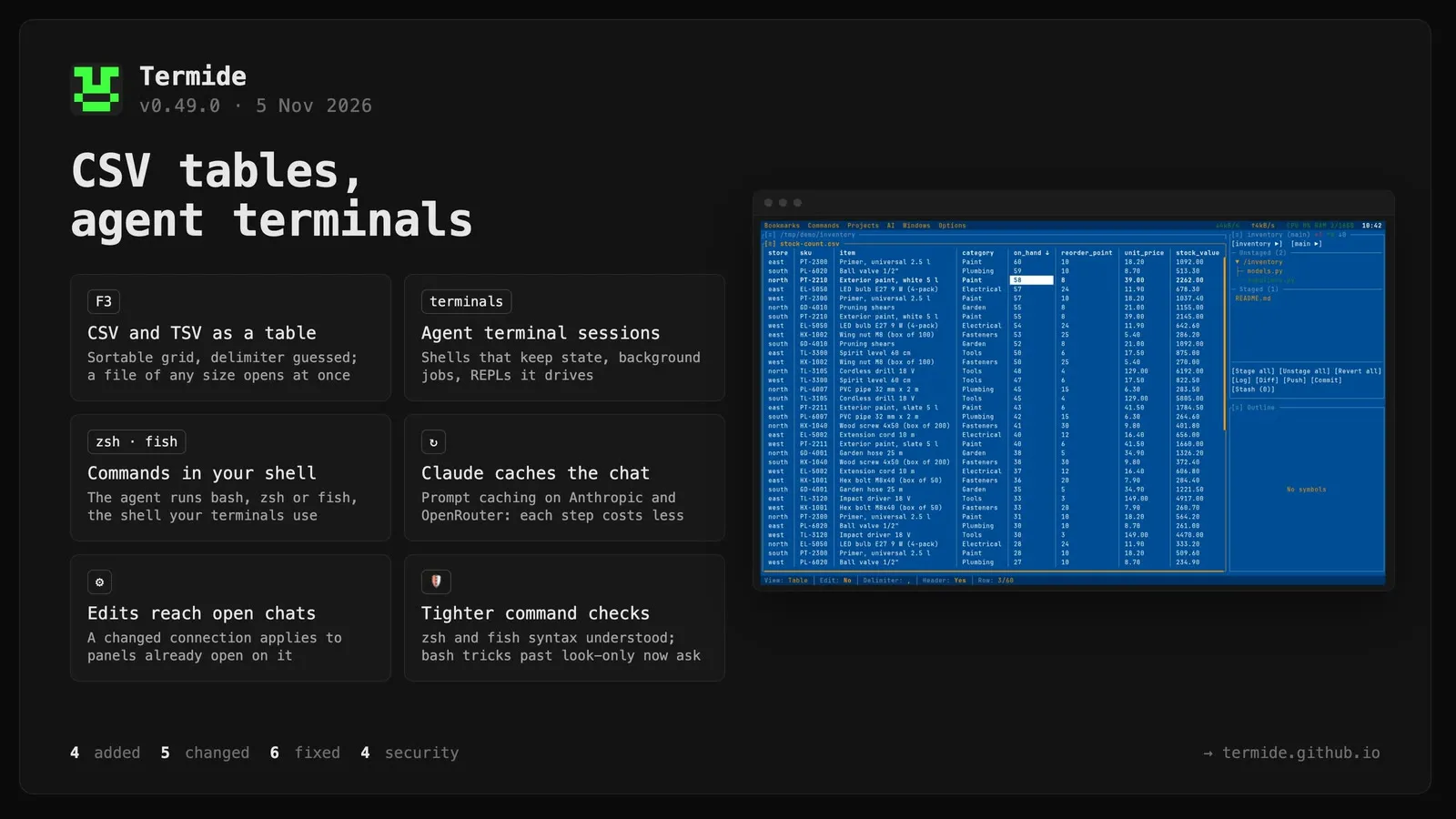
CSV and TSV files open as a table.F3 in the file manager, Open…, a bookmark or a followed link shows a delimited file as a grid with column headers and a cell cursor; Ctrl+E switches to the source in the editor and back. The delimiter (,, ;, Tab, |) and whether the first record is a header are guessed and switch from the status bar or the panel menu; a header click or s sorts a column — numbers by value — and y copies a cell, the menu a whole row tab-separated. The file is not loaded into memory: a background pass finds where its rows start and only the rows around the screen are read from disk, so a file of any size opens at once and scrolls, sorts and follows a scrollbar drag anywhere in it. See CSV Table Viewer.
Terminal sessions for the agent.shell takes session to run a command in a named terminal that keeps its directory, variables and background jobs between calls, and background to start a long command — a dev server, a watcher, a slow build — and return while it runs; a command in a terminal that outlives its timeout runs on rather than being killed. The new terminals tool lists the agent’s terminals, reads what one printed since it last looked, types into one — text and keys by name — and waits for a text, for the shell to finish the command typed at its prompt (with its exit code) or for the output to settle before returning what came back (the screen, for a full-screen program), shows a terminal’s screen, interrupts its command or closes it, so the agent can drive a REPL, a debugger or a prompt. A line a program redraws in place, such as readline’s, reads as the screen shows it. The agent is reminded of its open terminals before each request. A terminal belongs to the agent session and ends with it: when its panel closes or switches session, when termide quits, or when a subagent’s task is over; a subagent’s terminals are its own. [ai] max_terminal_sessions caps them per session (10 by default). The panel’s state strip shows each terminal with what it runs, and the status bar counts them; a click shows the terminal in a panel where you can type into it too, and closing that panel hands it back to the agent, still running.
Claude caches the conversation. Claude caches a prompt only when asked, so an Anthropic connection now asks for automatic prompt caching, and so does an OpenRouter connection for Anthropic’s models: each step of a run reads the conversation before it from the cache, at a fraction of the input price, and the status bar counts those tokens under ↻. A gateway that refuses the field is asked again without it.
Termide names itself where usage is filed by app. A hosted endpoint that keeps a breakdown of inference by the application that sent it — OpenRouter today — filed termide’s requests under Unknown. A connection now names termide there: its name and address as the app, and its categories. This is on by default; a connection’s page in the AI settings gains Identify as Termide (app_attribution) to turn it off, and the row appears only for an endpoint that keeps such a breakdown — a local llama.cpp, vLLM or Ollama ignores the headers, so there is nothing to switch there. The app’s page at the service is shared by everyone sending that address and its usage shows in the open, so it is yours to switch off per connection.
Changed
The agent’s bash tool is now shell. The tool that runs commands is named for what it does rather than for the shell behind it. termide renames it once in what it keeps itself: [ai.permissions.bash] in the global config and in rules granted for projects, tools in the global ai/hooks.toml and the global agents’ tools:, the calls in session logs; an untouched ai/tools/bash.md is replaced by ai/tools/shell.md (an edited one moves there, with the new default beside it as .new). A project’s own files are not rewritten — a bash left there is reported, and still applies through this release only. What changes for scripts: a hook’s input names the tool "shell", and an external agent sees termide’s tool as mcp__termide__shell.
The agent runs commands in your shell.shell and the agent’s terminals use the shell terminal panels do — terminal.default_shell, or the one found on the system — when it is bash, zsh or fish, and bash otherwise; the tool’s description names the shell to the model, and a terminal reads your startup file for it (.bashrc, .zshrc, config.fish). On Windows that is Git Bash where it is found.
An edited connection reaches the panels already open. A connection changed in the settings used to apply only to agent panels opened afterwards; one already open kept answering on the endpoint, model and window it started on until it was reopened. Each open panel on that connection now takes the change, keeping its conversation; a run going on finishes on the old endpoint and moves when the turn ends.
The state strip keeps fresh launches in sight. Above the input, the running subagents, the commands moved to the background and the agent’s terminals each listed the oldest first and showed three, so whatever was just started was the first folded into +N. They now list the newest first and show five before folding the oldest away; the queued messages still run in the order the agent takes them.
A tool name no tool goes by is reported. A name in an agent’s tools: or a hook’s tools, and a config’s [ai.permissions.<tool>] table, that names no tool used to apply to nothing in silence; it is now reported under the agent’s banner or among the config warnings. MCP and plugin tool names and wildcard patterns are taken as they are.
Security
Commands are judged in the syntax of the shell that runs them. In zsh a glob qualifier such as *(e:'cmd':) and an expansion flag such as ${(e)x} count as substitution and ask; in fish (cmd) is a command substitution, and a fish command the rules cannot read as a whole — switch, function, an escape such as \x41, a here-document — always asks and gets no rule.
Three ways to slip a command past the look-only check are closed. The agent’s commands that only look ran without asking, and a few that run something passed for them: bash 5.3’s ${ cmd; } and ${|cmd; }, which run a command as $(…) does; an array subscript in test -v, [ -v ] or a [[ … -eq … ]] comparison, which bash evaluates and substitutes in even within single quotes (test -v 'a[$(cmd)]'); and an option of find, sort, rg and the like written with quotes or a backslash inside it (find . -del''ete). Each of them now asks.
A variable’s value is not run as code without asking. bash evaluates some values as arithmetic or a prompt and runs the substitutions in them — an operand of [ … -eq … ] and the like that is not a number, the variable of test -v, ${!x}, ${x@P}, a subscript or substring offset given by a name (${a[i]}, ${s:i}) — and a terminal session keeps the values an earlier command set. These now ask, so [ "$n" -gt 3 ] asks too.
SSH and SFTP on russh 0.65, past the advisories against 0.64: agent signing without confirmation, unbounded allocations on crafted EXT_INFO and CONSTRAIN_CONFIRM messages, a channel stall on a zero maximum packet size, and Pageant frame buffering.
Fixed
OpenRouter models showed by id and on the fallback window. The Model chip now lists each model by the name OpenRouter gives it beside its id, and Context: adopts the model’s context_length, as it does vLLM’s and omlx’s max_model_len, instead of the configured fallback.
The settings listed a CLI agent’s models by their ids. The model dropdown of a Claude Code, Codex or Gemini CLI connection, and the field showing the chosen one, now show the names the agent gives its models; the id is still what is stored. A dropdown is also wide enough for its longest option instead of cutting it.
Codex’s commands and edits came through half-described. Codex sends a command as its title or a word list, names the file of a read or an edit only in its locations or diff, and asks permission for an announced call by its id alone; such calls showed without their command or path, and auto judged the permission requests blind. They now carry what they run and touch, and are judged as the edit or command they are.
Gemini CLI’s spending was miscounted. Its cached input was counted twice and its thoughts left out of the output; the session’s totals now count them as for the other agents.
A Codex or Gemini CLI thought showed its subject with asterisks. The bold subject that heads each thought, folded headline included, now shows without its marks.
A streamed tool call kept one identity only when its id came first. From an endpoint that sends a tool call’s name before its id, the call’s start went out under a stand-in id while its arguments and its end carried the real one. All three now carry the same id, and the message keeps the server’s.