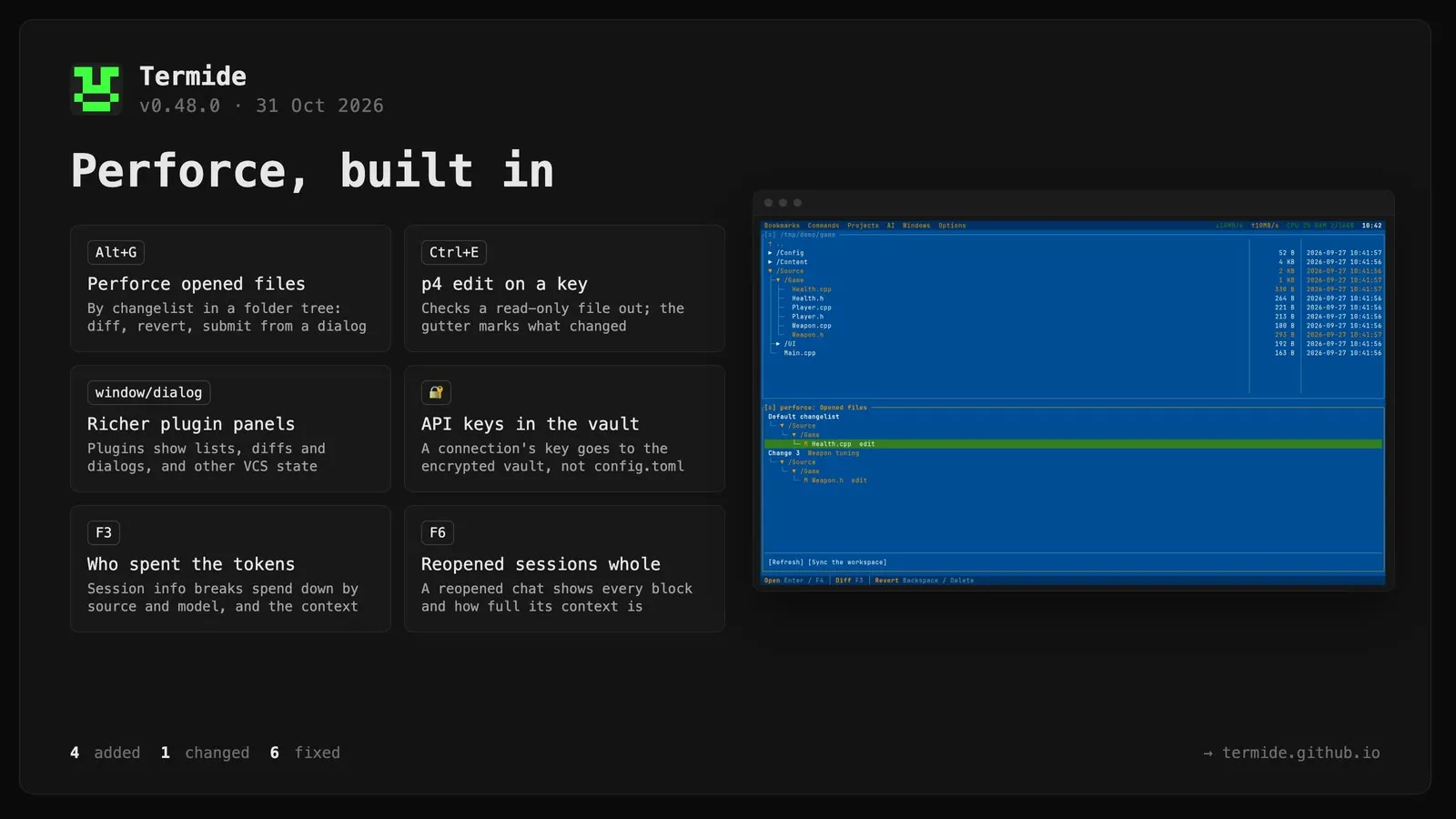
Perforce, built in. termide carries a Perforce plugin: nothing to download, the same on Linux, macOS and Windows, with p4 on PATH all it needs. It is off until turned on, in Settings → Plugins or as [plugins.perforce] with mode = "on" in the global config; mode = "opt-in" leaves it to each project, whose .termide/config.toml turns it on with enabled = true. The status bar tells where the file in the editor stands: p4: #3/5 (out of date), p4: edit #5/5 · change 1234, also opened by …, locked by …, not in depot. Ctrl+E in a read-only file opens it for edit, asking first when someone else has it open and refusing when it is locked; turned off in a file you have opened, it asks whether to keep it opened or revert it, and with unsaved changes whether to save or discard them. Alt+G in a project outside git lists the opened files by changelist in a tree of folders, with git status’s keys: Enter or F4 opens a file, F3 shows its diff in the diff panel, Backspace reverts it, Space lists what can be done with it, and Enter on a changelist submits it — the default one from a dialog that takes the description and the files to send. The command palette opens a new file for add, shows the file’s diff and syncs the workspace in a terminal. Opened files take their colour in the file manager, lines changed against the depot are marked in the gutter as for git, and the agent gets opened, diff and edit tools. A plugin of the same name in the plugins directory takes its place.
Plugins can stand in for another version control.files/status colours files in the file manager in git’s colours, the folders above them included, and editor/base gives the text the gutter marks changes against; git still comes first in both, so they fill in only where git has nothing to say. file/will_edit hands Ctrl+E to a plugin first — turning editing on in a file that is read-only on disk, or off in a writable one — so it can check the file out or revert it and have unsaved work saved or discarded. A command with "replaces": "open_git_status" runs on Alt+G in a project outside git. A plugin’s panel may be a list — groups of rows with actions, run with git status’s keys, rows with a path in a tree of folders, buttons under them — or a diff shown by the diff panel, and window/dialog asks in one window made of a message, a text field, a list to pick from or tick, and up to six buttons.
API keys in the password vault. A connection’s page in the AI settings has an API key field: the key typed there goes into the encrypted vault under the connection’s name, never into config.toml, and the field shows only whether one is stored. A variable named by api_key_env still comes first. A key in a locked vault asks for the master password when a request needs it. Renaming a connection moves its key, deleting it removes the key. A key pasted into api_key_env by mistake is shown masked with a warning and moves into the vault in one step. A run from the command line cannot unlock the vault and needs api_key_env.
Who spent a session’s tokens. The agent panel’s session info (F3, /usage) breaks the tokens down by who spent them — the conversation, subagents, the auto reviewer, recall’s solver, summaries, the /goal judge, /handoff, and what Claude Code spends inside itself — and by model, with the share the cache served and, where the provider reports it, the output spent reasoning. It also shows what fills the context — system prompt, tool definitions, skills, tool output, conversation, summary, and what a CLI agent holds of its own — and what each tool’s results cost while they stayed in it. The figures come from the session log, so a reopened session shows them, the status bar’s totals continue from what the session had spent, and a fork counts only its own.
Changed
Claude Code and Codex review on their cheapest model. With no reviewer named, the auto mode reviewer of a Claude Code or Codex session ran on the session’s own, usually frontier, model, about a third of the Claude Code spend termide drove. It now runs on the cheapest model the CLI offers — Haiku for Claude Code — or on the session’s when it offers none; a reviewer named in [ai.auto_reviewer] or on the connection still wins. Its calls also use Claude Code’s five-minute cache rather than the twice dearer one-hour one.
Fixed
A reopened agent session shows its whole conversation and how full its context is. Reopening a session, or restarting termide, showed only what its last compaction left — the summary posing as your first message — and put the context at 0 until the next reply. The panel now shows every block, with the compaction’s notice where it happened, and the context’s fill as it was.
A Claude Code or Codex reviewer’s tokens are counted. The auto reviewer, recall’s solver and the /goal judge run on Claude Code or Codex reported nothing spent, so the session’s totals left them out.
Leaving edit mode asks about unsaved changes.Ctrl+E or a click on Edit: Yes with unsaved changes switched the editor to viewing and kept them out of sight, in the hex editor too, so closing it later could lose them. It now asks: save and view, discard and view, or keep editing.
An open file follows its write permission. A file opened read-only stayed read-only in the editor after something outside made it writable, chmod +w or a version control checkout, until it was reopened. The editor now follows the permission when the file changes on disk, both ways, except over unsaved work; Ctrl+E overrides it until it changes next.
An external agent that exits at once says why, with the last line it printed, instead of “Broken pipe”.
The agent’s write into a pipe or a device no longer fails on Linux after the data went through.