Termide 0.45: plugins, and delegates in view
Extend termide with your own programs, and keep an eye on the work your agent hands out
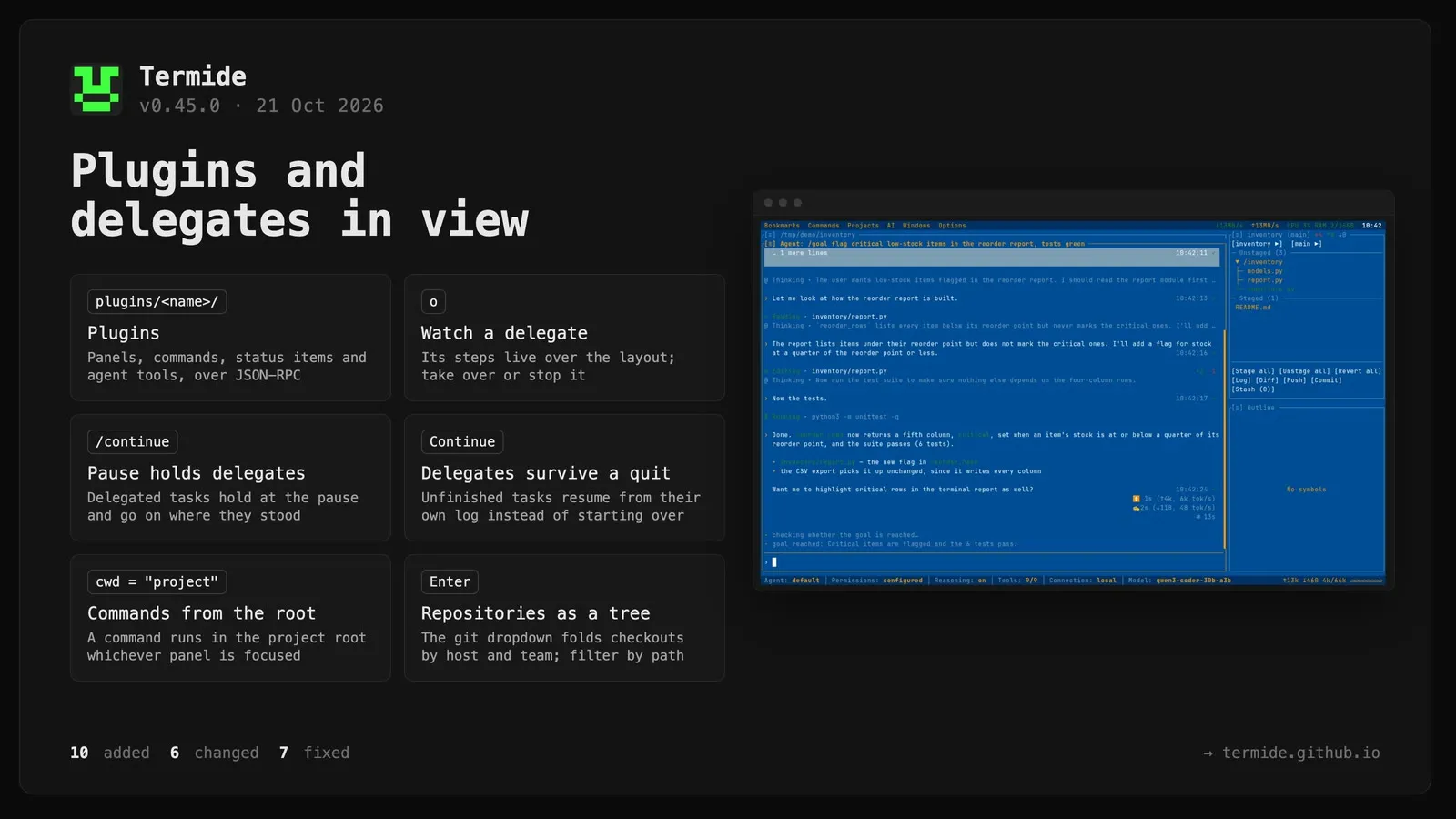
Added
- A panel’s pause holds the delegates it handed over. Pausing a panel stopped only its own loop: a delegate ran to the end of its task and a background one ran on untouched, so the panel stood at
‖while its work went on behind it. Each task now holds before its next request or call and goes on where it stood when the pause is lifted — by/continue,[▶], or a withdrawn pause; giving up the paused run and stopping it free what was held too. The pause’s row in the state strip counts them (‖ Paused · 2 waiting), and a view of a held delegate says so on the rule above its buttons. A delegate run by an external agent runs its own program, which no pause can hold: it keeps going, is counted apart (· 1 keeps running), and only stops. - Delegated tasks survive termide closing, and are carried on by the panel that delegated them. A delegated task’s log now records its run’s start and end,
pausedwhen the task stood at its panel’s pause, so a task termide quit upon reads as unfinished and shows⏸ &in the session lists. The panel that delegated them is the one to carry them on, so it keeps them in view rather than opening panels: each unfinished delegate holds a row above the input (& task · find the loader · search — unfinished), and clicking the row opens that session, where its own card asks. No delegate’s panel opens by itself. Continue on the carry-on card carries the panel’s own work on and, with it, every delegate it left behind: each runs again out of sight under thetaskcall that handed it over, taking its steps back from its own log — what it did stands there, so it goes on rather than starts over — and answering the panel that delegated it when it is over; its permission requests come to that panel as cards. A panel with nothing of its own left unfinished asks about its delegates alone, and there Continue starts only those. Decide later leaves the rows and the tasks in the session lists (F6); a delegate that cannot be carried on there says so in the panel that asked. - Commands that run from the project root. A command ran in the directory of the focused panel, so the same line meant something else after every navigation:
cargo testtested one crate from a deep panel,./scripts/deploy.shfound nothing at all.cwd = "project"incommands.tomlruns it in the project root whichever panel is focused, in every mode, the terminal included, with direnv resolved from there; left unset it follows the focused panel as before. The command’s create and edit form has a Run from the project folder box for it, so the file no longer has to be edited by hand. Where a command runs is part of what its approval covers, so moving a project’s command to another directory asks again. - A project’s repositories as the tree they live in. A project that is a folder of checkouts grouped by host and team listed its repositories in one flat list by folder name, so two
crmcheckouts could not be told apart. The repository dropdown of the git panels now draws the tree with the file tree’s lines: folders as dim rows that fold withEnter,←/→or a click, and the repositories under them; opening it reveals the current one. A folder named like the repository inside it adds no row, and a project whose repositories all sit directly under it stays flat. The closed selector shows the path inside the project, and the filter matches it, so typing a host or a group finds what is under it. - An agent delegates to a copy of itself.
taskwas offered only when there was another agent with termide’s own loop to hand work to, so a lonedefaultagent, as in a fresh setup, had notaskat all. Every such agent can now hand a task to a fresh copy of itself: a clean context for a search, or work running in the background. A delegate still gets notaskof its own, so delegation does not nest. - Web search without a browser.
web_searchwas offered only with a Chrome-family browser to run the search in, so where none runs — Termux, a server without a GUI — the agent had no search at all. Without the browser the engine’s results page is now fetched over plain HTTP, asfetchdoes, so the tool is offered whenever an engine is set. DuckDuckGo, the default, works this way; an engine that builds its results with JavaScript (Google, Bing) returns none, and the call says so. - Watch a delegate at work. A task running out of sight showed only a few lines in its block until it was over.
oon its block, or a click on its row above the input, now shows a view of it over the layout, so that no column moves: the delegate’s steps as its session log gains them, and the permission requests and questions it puts to you while the view is up. It ends in a row of buttons with their keys: In a panel F9 moves the view into a panel of its own, Take over Ctrl+T takes the task over and Stop stops it, each of the last two after a confirmation, and Close Esc; a panel following a task has[✎]and[■]on its prompt’s border instead. Like a modal, the view holds the window while it is up;Esccloses it and the task goes on; once the task is over, the view shows it as it ended, and in a panel its session opens to go on talking to. - External agents as delegates. An agent with a
commandwas never among thosetaskcould hand work to, and the docs’ “only in a panel” had no way in. It is now listed with the others, and its task runs out of sight like any delegate’s: its own program, started for the task and ended with it, with its own tools, its progress in the task’s block, its session kept, and its permission requests put to you in the delegating panel. - All running subagents, on a click. Past three running subagents the strip above the input showed
& +Nand nothing more. A click on it now shows them all, with a& ▴row after them that folds them back. - Plugins. A program copied into
plugins/<name>/beside the globalconfig.toml, with aplugin.tomlnaming it, runs in the background for each open project and speaks JSON-RPC on its stdin and stdout: it hears files opened and saved, adds commands to the palette and the Commands menu, shows items in the status bar, opens panels of its own drawn from the Markdown it sends (aplugin:<action>link is a button back to it), asks in termide’s windows — a question, a choice, a line of text, a form — headed with its name so that none passes for termide’s own, marks lines in the editor beside the language servers’ diagnostics, reads and edits the project’s open buffers (an edit is one undo step), opens files and terminals, hears focus, change, close and git events, gives its commands keys of their own, notifies, and gives the agent tools that report progress. It may answer completion, hover, code actions, go-to-definition and references in the editor beside the language servers, or for a language without one; it may edit a file beforeCtrl+Swrites it (file/will_save, formatting on save) and hear an agent’s runs start and end. The palette shows the plugins’ state, reads the plugins directory again and restarts a plugin, and the settings have a Plugins tab for their modes and the project’s switches. The globalconfig.tomlgives each plugin a mode —on,opt-inoroff— and a project’s.termide/config.tomlcan only switch it within that mode, so no repository wakes a plugin you did not allow. A plugin that keeps crashing is restarted with backoff and given up on after three crashes in a minute. Seedoc/en/plugins.md;examples/plugins/holds a small Python library for writing plugins and three plugins built with it.
Removed
subagent_runand delegated tasks in panels. Where a delegated task ran was a setting ([ai] subagent_run, Delegated tasks run in the settings,subagent_runin anAGENT.md): out of sight, in a free agent panel, in one opened for it, or as a card asked. Every delegate now runs out of sight, asks you what its rules leave open in the panel that delegated it, and is watched in a panel you open on it when you want to, so the setting, its card and the panel a task took over are gone. The key is ignored inconfig.toml; in anAGENT.mdit is reported as a key termide does not read.
Changed
- Repository discovery stays inside the project. Nested repositories and submodules are now looked for three levels under the project root instead of two, so a layout like
<project>/<host>/<group>/<repo>lists its checkouts where it listed none. A repository that contains the project — a dotfiles repository over the whole home, a parent monorepo — no longer joins the git panels’ list once the project’s own repositories are found, where it could become the default one; it stays when nothing at or under the root is a repository, as for a project opened atrepo/src. - Git network failures name the repository and the server. A failed fetch, pull or push said only
git fetch failed; with many repositories on different servers in one project, it now says which:git fetch services/api (gitlab.corp): …. - Background tasks run out of sight. A
taskhanded over in the background took an agent panel, a free one or a new one beside the others, and changed the layout for as long as it ran. It now runs out of sight as a task the call waits for does, and has a row above the delegating panel’s input — the delegate, the task, what it did last and its time — whose✕stops it, after a confirmation, and whose click shows a view of it. Its cards stay up when the delegating panel’s own run stops, and closing that panel or its project stops its tasks, after a confirmation that counts them. The panel’s session stays while they run, as it does during a run: a new session, another one opened or a switch of model or agent waits for them. - A project’s MCP server is approved with a tick in the toolset list. A server waiting for
/trusthad a[✓]button at the right end of its heading, which closed the list as it approved. Its heading now has a checkbox of its own on the left, unticked ([ ] MCP: ext); ticked, it is approved at once and the list stays open: the server connects and its tools appear under the heading, on, even if the session had switched them off. The buttons that remain —[↻],[⇥]/[⇤]— no longer close the list: they do what they say and the list stays open, brought up to date. - Every running row of the strip stops from its
✕. Only a task handed over in the background had a✕on its row above the input; a subagent the agent waits on and a command the agent moved to the background could be stopped only by stopping the whole run, or for a subagent from a view of it. Each of them now has a✕that stops it alone after a confirmation, worded alike wherever a task is stopped: it names the delegate, as the view’s Stop now does too. - A delegate asks you instead of being refused. A delegated task running out of sight could do only what the rules and the mode already allowed: anything that would have asked was refused, though you were right there in the panel that delegated it. Its permission requests now come to that panel on the usual card, headed
& <delegate> ·as its questions are, for termide’s own loop and for a copy of Claude Code alike; only atermide --promptrun, with no one to ask, still refuses them. Delegates working side by side ask in turn, one card at a time, where a second question at once used to be turned away. What you grant a delegate for the session holds for its task alone, and “always” is not offered it.
Fixed
- A restored git panel sees the whole project. The git panel a saved layout reopened at startup listed the one repository it was saved on, with neither the project’s other repositories nor the tree they sit in; only a panel opened from the menu had them. It now finds them as a new one does, and keeps its repository chosen.
- Scrolling up the repository and branch lists no longer jerks. The lists kept the cursor pinned to their bottom edge; the window now stays put and moves only when the cursor leaves it.
- A Claude Code panel’s delegate could not be watched. In a panel on Claude Code a click on a running task’s row, or
oon its block, did nothing: termide’s tools serve Claude Code over MCP, which gave each call an id of its own, so the task was registered under an id its block did not have. A call now takes the id the agent announced it by, and a view of the task opens as it does in a panel on termide’s own loop. - An external agent that fails to start says why. When its program went away at once —
npxrefusing to run an adapter whose cached copy had lost its executable bit, a missing login, a crash — the panel, a delegated task or the auto mode’s review showed onlyinitialize: the agent closed the connection, and the reason went to the log atdebug. The failure now ends with the last line the program printed, as a debug adapter’s does:initialize: the agent closed the connection: sh: …/claude-agent-acp: Permission denied. - The
Toolschip agrees with the list. A session that had switched off the tools of an MCP server took them all off the count, offered or not: resumed while that server had not connected — a project’s server waiting for/trust, one gone from the configuration — it showed0/25with every box in the list checked. The chip and the banner now count the list’s items and the checked ones among them. install.shon systems without glibc. The installer always picked the gnu build on Linux, which needs the system’s glibc loader; where there is none — a 32-bit Raspberry Pi OS booted with a 64-bit kernel (arm_64bit=1), Alpine, NixOS — the installed binary failed with “No such file or directory”. It now checks for the loader and installs the fully static musl build when it is missing.- The system monitor shows small amounts of RAM in megabytes. Below 2 GB it now reads in MB: a board with about 0.9 GB showed
RAM 0/1GB, since whole gigabytes rounded the total up and the usage down.
Security
- Distrusted emSign certificates are refused. The TLS stack termide uses for HTTPS and FTPS — the agent’s connections and web tools, the FTPS file manager — could accept a certificate chain through distrusted emSign intermediates, whose private keys are now public (RUSTSEC-2026-0381, RUSTSEC-2026-0382). It now rejects them.
- A project’s config can no longer name what termide runs or loosen the agent.
.termide/config.tomlcomes with the repository, and it could set a debugger’s or an LSP server’scommandandargs, the terminal’sdefault_shell, the web tools’chrome_path, the logfile_path, a connection’sbase_urlandapi_key_env(sending a key from any variable to any server), and the agent’s permissionmodeandallowrules. These now come from the global file only; in a project file they are ignored with a line in the log, and the settings window shows them as set in the global settings when it stores in the project. A project may still make the agent ask or refuse. A shell picked from the menu is now saved globally. - A project’s MCP servers and hooks wait for approval. A server from a project’s
mcp.tomlor any.mcp.json, and a hook from a project’shooks.toml, used to start on their own when an agent panel opened. They now wait: the panel says what each would run,/trustlists them and/trust <name>approves one as it is configured now, kept in termide’s data directory; a change to its command, arguments, environment or address makes it wait again. A project can no longer switch off or replace one of your own hooks. - A project’s commands ask before their first run. A command of the project’s
commands.tomlran as soon as it was picked, or as soon as its hotkey was pressed — and a repository could bind one to any key, plain letters included, so typing in the editor could run it. Its first run now shows what it runs, itsbuildincluded, and asks; the approval is kept outside the project and holds while the command stays as it was, and until then its hotkey asks only if it is held withCtrlorAltor is an F-key; a key text is typed with is bound only once the command is approved. Commands written in termide’s own forms are approved as they are saved. - A project’s agents cannot loosen the mode or start a program. An
AGENT.mdunder a project’s.termide/ai/agents/could start inall— and the model could delegate to it by itself — or be an external agent whosecommandtermide ran when it was picked. A project’s agent now starts only inplanorask, and external agents are defined in the configuration’sagents/only. - Search engines come from the configuration only. A project’s
ai/web/engines/<name>.tomlcould redefine an engine, sending the agent’s web searches to a server the repository chose; only the configuration’s engines are read now. - “Allow always in this project” is kept outside the project. The rule goes to
trust/<project path>/permissions.tomlin termide’s data directory instead of the project’s.termide/config.toml. Rules an earlier version wrote there are now ignored, since termide cannot tell yours from a repository’s: answer “allow always” again once, or move them to the global file.