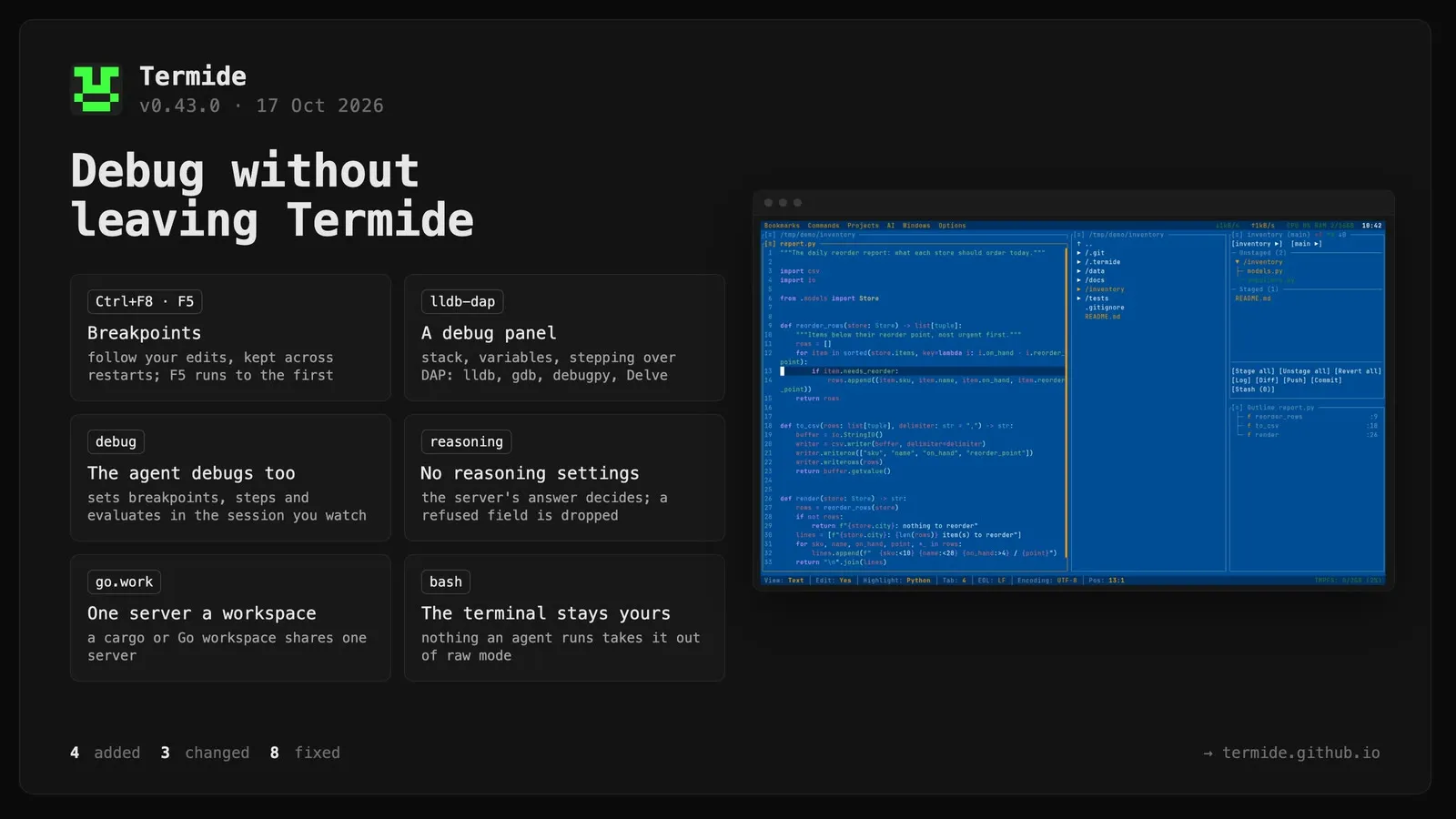
Breakpoints and a debug launch.Ctrl+F8 in the editor, or a click on a line number, sets a breakpoint on the line, drawn as ● beside the number; it stays with its text as lines are added or removed above it, and is saved per file across restarts. F5 starts a command-line debugger in a new terminal panel with the project’s breakpoints set and runs the program to the first one: a command in commands.toml with debugger = "lldb", "gdb", "dlv" or "pdb" names the program to debug (with an optional build to run first), and a Python or Go file needs no command at all. Several launches are offered as a list. The command palette has Start debugging and Remove all breakpoints from any panel, and so does the editor’s [≡] menu, and debug commands show 🐞 in the Commands menu.
Debugging inside TermIDE over DAP.debugger = "lldb-dap", "gdb-dap", "debugpy" or "dlv-dap" drives a debug adapter and shows the session in a new debug panel: where it stopped and why, the call stack, the variables of the selected frame as a tree that opens on demand, and the program’s output. c continues, n, s and o step over, into and out, p pauses, x stops, r runs the launch again — its build first, with the same parameters — and e evaluates an expression; F5 in the editor continues too. The line the program stopped at is marked → in the editor’s gutter and followed as you step, without taking the focus from the panel, and breakpoints changed during the session reach the adapter at once. A Python file debugs under debugpy and a Go file’s package under dlv dap with no command when they are installed.
The agent drives the debugger. The panel’s agent gets debug: it sets breakpoints, starts a debug command or a Python or Go file, steps, selects frames and evaluates expressions, and each answer is the session as text — where it stopped, the call stack, the variables and the last output. Starting and stepping wait for the next stop. The session is the one in the debug panel, opened beside the others without taking the focus, so the user can watch and step it too. In plan mode only state is allowed.
The debugged program reads the keyboard. A program debugged through an adapter runs in a terminal panel of its own beside the debug panel, so it can be typed to and shows its output as in any terminal. debugpy and Delve ask for it with runInTerminal; lldb-dap, whose own terminal launcher fails on macOS, is pointed at the panel’s terminal device through lldb’s target settings. console = "panel" in commands.toml keeps the output in the debug panel instead, as GDB’s adapter and the agent’s sessions always do.
Changed
A queued message has a ✕. Its row in the agent’s state strip, which already showed how long it has waited, now ends in a ✕ like the goal’s and the loop’s; a click on it takes the queue back into the input, as ↑ does.
Reasoning and its echo need no settings: the server decides. An OpenAI-compatible connection to OpenAI, OpenRouter or the Gemini API sends the reasoning level as reasoning_effort; any other server, whatever its address, gets chat_template_kwargs.enable_thinking and the model’s reasoning of the current turn back — the answers since your last message, between the turn’s tool calls — as reasoning_content and as reasoning (the field Ollama’s OpenAI layer reads, ollama#18534), with preserve_thinking, without which llama.cpp’s Qwen template drops it. The reasoning of earlier turns no longer goes back: it cost input tokens on every request for little the model used, and the Qwen and DeepSeek templates drop it themselves. A server that refuses one of these fields — a 400 or 422 naming chat_template_kwargs, reasoning_effort, return_progress, reasoning_content or reasoning — gets the request again at once without it, and every session and side call on that server leaves it out until termide restarts, when an upgraded server is asked again.
One language server per cargo or Go workspace. A crate that is a member of a cargo workspace higher up, or a Go module listed in a go.work, used to get a server of its own, each loading the same workspace again; the server now starts at the workspace root, so all its members share one. Membership is asked of the toolchain — cargo locate-project --workspace, go env GOWORK and go work edit -json — rather than read from the manifests, once per package; a standalone crate or module, one under a workspace it is not a member of, or a missing tool keep the nearest marker as before. The query never starts a toolchain download.
Fixed
Nothing an agent runs can take over termide’s terminal. The agent’s bash started its commands in a process group of their own but kept termide’s controlling terminal, so whatever they ran — a debugger, stty, a password prompt — could open /dev/tty and take termide out of raw mode: every key then showed on screen as an escape code with a bell, and no hotkey, not even quit, worked. A command now runs in a session of its own, with no controlling terminal; a program that asks for one gets an error instead of termide’s terminal.
A session runs in one termide at a time. A second termide opening the same project — while the first still ran in a terminal window closed by mistake, which kept it alive out of sight — took the first one’s run under way for one cut off, offered to carry it on, and so ran the same Claude Code session twice: two agents writing the same branches and running the same gates, each taking the other for a stranger. A session is now leased to the termide that holds it, through an OS lock on a .lock file beside its log, which the OS drops however that termide ends. Another termide shows it read-only, with no agent started and nothing sent or offered, names the process holding it, and takes it up once it is let go. Before, two panels of one termide were kept off one session, but two termides were not.
A /goal whose agent waits on you pauses instead of spinning. The judge has a fourth verdict, WAITING: the agent stopped on something only you or an outside event can settle — a question, an approval, a process or another session it will not touch. The goal then pauses at once, still set, as one that only talks does; before, it was sent back every turn, restated the wait with a status check that defeated the no-tool count, and spent a full model call each time until the subscription ran out.
A tool the model made up is named in its block. An external agent’s call of a tool it does not have — a bash in place of mcp__termide__bash — showed as other, the kind ACP gives it; the block now shows the name called.
send_message and agents read like the other tools. Their blocks showed the raw tool name and JSON; they now read @ Writing to panel 7 · info: … and @ Listing agent panels.
Stopping the agent hands its queue back. A message typed while the agent worked and still waiting when you stopped it stayed in the state strip after the stop with nothing to send it, until ↑ took it back or the next request carried it along; an external agent dropped it with the cancelled turn. The stop now puts the queue in the input, ahead of anything typed, for you to send or change.
The hover popup renders Markdown. A gopls answer showed its ```go fences, the --- between its sections and the backticks and asterisks of inline markup as typed; Markdown hovers now go through the renderer the Markdown panel and the agent’s transcript use — code blocks highlighted behind a bar, rules as lines, emphasis and inline code styled. A plain-text hover is shown as it is.
Tabs no longer leave holes. A tab reached the terminal raw, which moves the cursor to the next tab stop without painting, so tab-indented text — a Go struct in the hover popup, a Go code block in the Markdown and HTML panels or the agent’s transcript — showed gaps with leftovers of earlier frames in them. Tabs are now expanded to spaces first.
Removed
The connection settings reasoning_param and send_reasoning (Reasoning parameter and Send reasoning back on a connection’s page). They chose by hand what the server’s own answer now settles, and their auto guessed from the host name: a server named .lan, or llama.cpp on a rented machine, got no reasoning switch and no preserve_thinking, so it dropped the model’s reasoning between the steps of a turn and the model answered with a number it had just invented instead of the one it had thought of (#62). A config that still names them loads; the keys are read past.
The connection setting prefill_progress (Prefill progress (llama.cpp)). Every server but the hosted APIs is now asked for its prompt-processing progress, so a llama.cpp server shows its prefill bar without being told to; a server that refuses return_progress is asked again without it, the others ignore it. A config that still names it loads.
Security
Updated zip to 9.0, clearing RUSTSEC-2026-0367 to 0369: its extract() kept setuid bits and followed links out of the destination. termide unpacks zip archives with its own code, which keeps names and links inside the destination, and never called extract(); the update clears the audit.