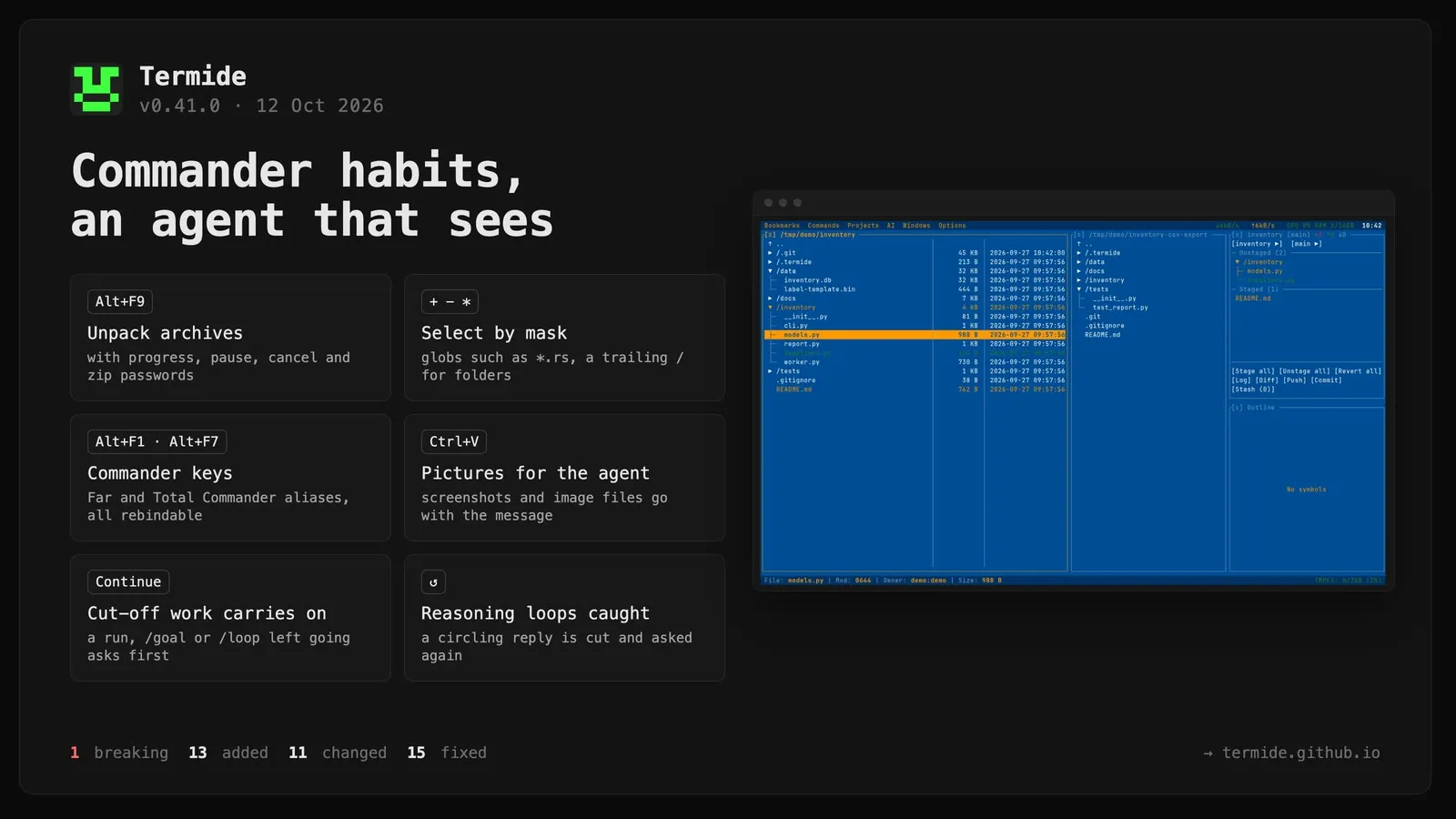
Termide 0.41.0: Commander habits, an agent that sees
Breaking Changes
Links open inside termide; [viewer] open_links and open_images are gone. A followed link opens a web address in the viewer, a file where Open… opens it, an image in the image preview, and a web bookmark always in the viewer. To open one outside, use O, Alt+Enter or Alt+Click in the HTML and Markdown viewers (open_external under [viewer.keybindings], rebindable, listed in Settings and the help) and Ctrl+Alt+Click in the terminal and agent panel, where Ctrl+Click still follows a link inside. The old keys in config.toml are ignored.
Added
Unpack archives with Alt+F9. The selected archives, or the one under the cursor, unpack through the Operations panel with progress, pause and cancel. The prompt offers a directory named after the archive in the other file manager’s directory, the other panels’ directories or the archive’s own; several archives get a directory each. An encrypted zip asks for its password first, and again when it is wrong; unpacking over existing files asks first. Unpack and pack failures are worded in your language.
Select by mask.+ and - in the file manager select and unselect what matches a mask — glob patterns, case-insensitive, a trailing / for directories (*.rs *.md, target/) — and * inverts the selection. Alt+Click toggles a row like Ctrl+Click, which macOS terminals turn into a right click.
Mount points in the directory switcher. On Linux and macOS it lists the root, mounted disks, removable media and network shares, leaving system mounts out.
Far / Total Commander aliases in the file manager, beside the existing keys: Alt+F1 directory switcher, Shift+F4 new file, Alt+F5 pack, Alt+F7 search, Alt+F9 unpack. All are rebindable.
Pictures in the agent prompt.Ctrl+V attaches a picture on the clipboard (a screenshot, an image copied in a browser) or picture files copied in a file manager, and pasting or dropping the path of a PNG, JPEG, GIF or WebP does the same. Each stands in the prompt as [#1 pasted image 1280×720] and goes with the message while the placeholder is there; pictures over 1568 px are scaled down. External agents get them when they declare image support. On macOS use Ctrl+V: Cmd+V is the terminal’s own text paste.
Work left going when a panel closed can be carried on. Closing the panel or termide during a run, /goal or /loop now asks first. A session reopened with a run cut off or paused, or a goal or loop left going, says how far it got and offers Continue, Drop it or Decide later; nothing runs by itself. Calls the cut-off run left without a result are not repeated blindly: the model is told they may have run in part.
Running subagents stay in sight. The state strip above the input keeps a row for each running task call, & Delegating to agent · task with what it did last, a spinner and its time, so one whose block has scrolled away still shows it works; a click on the row brings the block into view.
/goal can say a goal is out of reach. The judge may answer IMPOSSIBLE besides DONE and CONTINUE, which ends the goal.
Make, rename and delete directories in the directory picker. New project, Change root path and the other directory pickers take the file manager’s create_dir (F7/D, or a New folder button), rename (F2/R) and delete (F8/Delete). The name is typed into a tree row beside the entry under the cursor — at its level, not inside it — and Esc takes the row away; the new directory is left under the cursor, ready to pick. Only an empty directory can be deleted there.
A compression level for packing. The pack prompt (P) has a Compression row — None, Fast, Normal (the default) or Best — that sets the zip, gzip, bzip2 and xz level; zstd tells only None from the rest.
Limit a CLI agent’s context window. A Claude Code or Codex connection takes a Context window limit (context_window_limit) smaller than the model’s: Claude Code gets it as CLAUDE_CODE_AUTO_COMPACT_WINDOW (at least 100000), Codex as model_context_window through CODEX_CONFIG. The agent compacts at it, and the panel’s Context: shows no more than it.
A CLI agent’s models in the settings. Opening a Claude Code, Codex or Gemini CLI connection lists the models of its sign-in in the model dropdown, and the field shows a spinner while any connection’s models load.
A model that reasons in circles is caught. The built-in agent watches the reasoning and the answer as they stream; once most recent sentences restate ones already said several times, it cuts the call, keeps the reasoning up to where the circling began, tells the model what it kept going back and forth between, and calls it once more without reasoning. A second loop stops the run, and an active /goal with it, and shows those points for you to decide. Before, such a reply ran on to the output limit — 140 KB and 18 minutes in one case — and the run ended with nothing shown. Reword system/loop.md to change what the model is told.
Changed
One ticking timer everywhere. The agent’s run clock, subagents, pauses, /loop countdowns, the file operations panel and a remote connection’s status all show the same ✻ spinner beside the same duration: whole seconds as the two largest parts (45s, 1m13s, 2h5m, 3d4h), a zero smaller part left out (5m, 1h). The operations panel and the /loop interval used other formats before (1h 10m 5s, an untranslated 60m).
A stop reads as one line, then one status. While a run stops, the run clock gives way to stopping… ✻ 2s; the stopped answer then ends on a translated ✗ cancelled with its time and status. The stopping… notice and the provider’s raw aborted no longer both stay in the transcript, and sessions reopened from the log show cancelled too.
An active /goal and /loop stay in sight. The state strip above the input pins a row for each while it goes on, beside the running subagents: ◎ Heading for the goal … with how long it has run (and the judge’s check while it runs), ↺ Repeating every 5m … with its run count and the countdown to its next run. A click on the row’s ✕ stops it; elsewhere on the row brings its latest run into view.
Settings save as they change. The settings modal has no Apply: switches and dropdowns save when set, text and number fields on Enter. The bottom row is Stored: Global / Project, Reset and Close. Switching to Project creates .termide/config.toml; switching back asks whether to discard the project’s settings or move them to the global file. Reset asks first and resets a project to the global settings, or the global settings to the defaults. Keybindings changed there apply at once.
--config names the global file for saving as well as loading, with the project file on top; a missing or unreadable one is now an error. --no-lsp, --log-level and the Linux console theme are no longer written into the config files, and a detached instance keeps all three flags.
A /goal has no turn cap. It used to stop at 50 turns; now it ends when the judge finds it reached or out of reach. A goal whose agent only talks — three work turns in a row without a tool call — pauses, still set, for /continue or /goal stop.
A /goal can start while the agent works, and is taken at once. It used to be refused, and then queued as a steering message that a stop left behind; now nothing is queued, and once the run ends its first turn, headed by the /goal as typed, goes in place of the judge. Starting a goal no longer prints it twice. A stop or /loop stop also withdraws a loop turn still waiting in the queue.
CLI agents start from npm’s cache. Claude Code, Codex and Gemini CLI no longer ask the npm registry on every start, which cost seconds per panel, reviewer and subagent and over a minute offline; a newer release is looked for once per run in the background and used from the next start.
The AI menu dates its sessions as the panel does (YYYY-MM-DD HH:MM, dimmed), instead of “2h ago”.
The agent’s status bar shows only the connection name; the protocol stays in the welcome banner, and stands in only for a connection without a name.
The attention bell precedes the text in the menu bar (🔔 name), as icons do everywhere else.
Fixed
An external agent working on by itself shows that it works. Claude Code moves a running command to the background to take a message typed meanwhile, and goes on when it finishes — after its turn has ended. That work is now a run of its own: the clock ticks, the session cannot be switched or deleted under it, Esc stops it, and a message typed meanwhile goes as the next request. It ends once the agent has no call open and stays quiet (5 s after its answer, 30 s otherwise). A new session (F7) no longer inherits a ticking clock left behind.
A Claude Code request sent right after a quick stop no longer hangs. Stopped before it answered anything, Claude Code’s ACP adapter could go on with the cancelled prompt out of sight and keep the next one waiting behind it. An external agent stopped before its first reply is now started anew on the same session, which also ends the hidden work, and the transcript says so.
The /goal check shows that it is working. While the judge decides, the transcript shows the live line a model message has: the ticking clock, and with the built-in agent the reading progress (⏫) and the answer’s tokens. A long check on a local model no longer looks hung.
An active /goal or /loop rings the bell at its end only. A run the goal’s judge or the loop’s next run follows rings no bell, however long it took; the goal reached, given up, paused or failed, and the loop ended at its cap, ring.
A bare /goal or /loop no longer stops the active one. It reports it — the goal and its turn, or the loop, its run and the wait for the next — and shows the usage when nothing is active. Only stop (or off) ends either.
The /goal judge’s verdict is read past markup and a preamble. A judge that wrapped the word (**DONE**) or wrote a line before it was read as CONTINUE, and the work turn it sent told the agent only Still missing: CONTINUE.
A dismissed question no longer bars the agent from asking again. Its result told the model never to ask again, which in a long /goal kept it from asking about later decisions that were the user’s to make.
A failed /goal check no longer drops the goal. A judge call that errors is tried again after 10 s and 20 s; when those fail too, the goal pauses, /continue checks it again and /goal stop ends it.
A bash call no longer hangs on a process that left its group. A daemon or an ssh ControlPersist master that kept the output open held the call forever, even past its timeout or a stop; the output is now read until it goes quiet, and the result says when something was left running.
Claude Code’s tool calls show their full arguments. Its arguments arrive in pieces and only the first was kept, so a subagent call showed as default: with no task, in the panel and the session log alike.
Closing an agent panel no longer freezes the UI for up to 2 s per remote MCP server while their HTTP sessions were closed.
The mouse wheel scrolls the settings, the Keybindings tab included; before, the next frame snapped it back.
The paste placeholder reads as a phrase with the count declined ([#1 вставлено 6 строк]), and English no longer says “1 chars”.
Entering another open project applies its own settings, the global baseline follows every global save, and saving config.toml in the editor keeps the project overlay and the command-line flags. Config files are written through a temporary file.
install.sh uses the right Homebrew tap, termide/termide; the termide/tap it named does not exist.